How to Use Claude AI for Learning Programming in 2026
Lena was stuck learning Python until she discovered how to use Claude AI as a personal tutor. Learn the exact prompts and workflows to learn coding faster.
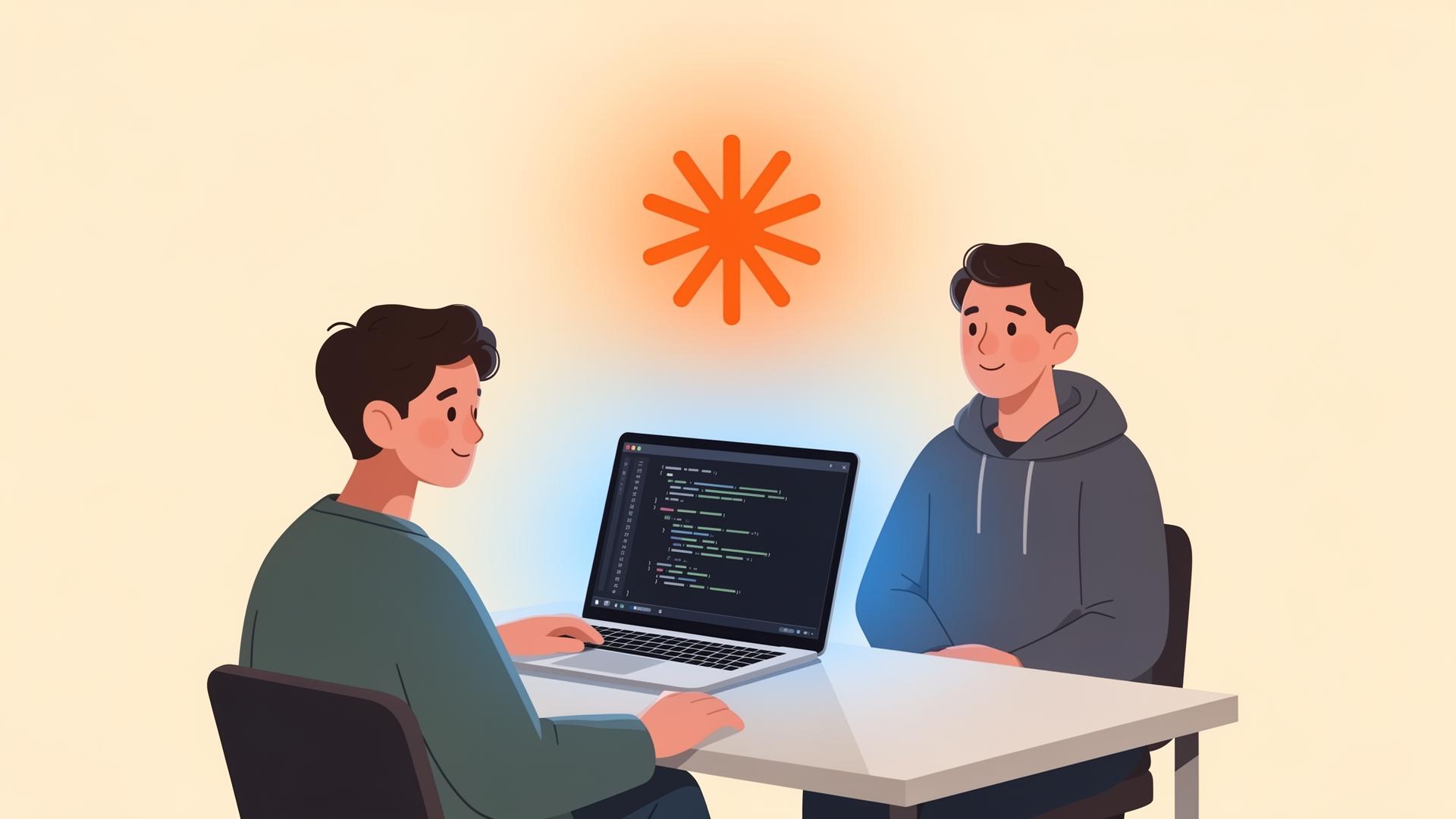
Lena, a 29-year-old graphic designer in Vilnius, was determined to learn Python. She’d spent weeks watching video tutorials, pausing and rewinding, trying to make sense of 'for loops' and 'dictionaries'. But every time she tried to build something on her own, a cryptic red error message would appear, and her motivation would crumble. It felt like trying to learn a new language with only a dictionary—she knew the words, but couldn't form a sentence. Then a friend showed her how to use Claude AI for learning programming. Suddenly, she didn't just have a dictionary; she had a patient, 24/7 tutor who could explain any concept and help her fix any error. The frustration melted away, replaced by the thrill of actually building something.
By 2026, stories like Lena's are becoming the new normal. AI isn't just a gimmick; it's a fundamental shift in how we learn complex skills. If you're on the outside looking in, wondering if you can break into tech, the answer is a resounding yes—and AI assistants like Claude are your secret weapon.
So, What Exactly is this Claude AI Assistant?
You've probably heard of ChatGPT. Think of Claude as its thoughtful, slightly more meticulous cousin. Developed by Anthropic, Claude is a family of large language models designed with a strong emphasis on safety, honesty, and helpfulness. While it can draft emails and write poetry just like other AIs, its real superpower for aspiring developers is its incredible reasoning and coding ability. It was built from the ground up to be a reliable partner, one that's less prone to making things up and better at understanding complex, multi-step instructions. For a beginner, this translates to less confusion and more tangible progress.
Why is Claude a Game-Changer for Beginner Coders in 2026?
Learning to code has always been a steep climb. It's not just about memorizing syntax; it's about learning to think like a programmer. This is where Claude shines, transforming the frustrating parts of learning into opportunities for growth.
Fewer "Hallucinations" on Code
AI models can sometimes "hallucinate"—that is, they confidently invent fake programming functions, libraries, or methods that simply don't exist. For an expert, this is a minor annoyance. For a beginner, it's a catastrophic roadblock. You can spend hours trying to debug code that was never going to work. Claude's architecture and training data make it less likely to do this. It will more often say "I'm not sure" or provide a well-reasoned, correct answer. This reliability is crucial when you're building foundational knowledge.
A Massive Context Window for Your Entire Project
This is Claude's killer feature. The "context window" is the AI's short-term memory—the amount of text it can consider in a single conversation. Older AIs had small windows, forcing you to re-explain your project constantly. The latest Claude models have context windows that can hold hundreds of thousands of words. What does this mean for you? You can paste the code from your entire project—multiple files, all the HTML, CSS, and Python—into the chat, and Claude can understand how it all fits together. You can ask questions like, "If I change this function in main.py, what will break in utils.js?" This is a level of a project-aware partnership that was science fiction just a few years ago.
The Patient, Non-Judgmental Tutor
Let's be honest: it can be intimidating to ask a senior developer a "stupid" question. With Claude, there are no stupid questions. You can ask it to explain a concept ten different ways until it finally clicks. You can ask it to re-write a function using simpler terms. You can be completely vulnerable in your lack of knowledge, and it will respond with helpful, encouraging explanations. This creates a safe psychological space that accelerates learning.
How to Use Claude AI for Learning Programming: Your Practical Playbook
Talking to an AI is a skill. The better your prompts, the better your answers. Here are some concrete workflows and prompts you can steal to get started.
1. Master Concepts with the Socratic Method
Don't just ask for definitions. Ask Claude to teach you and then test you. This active recall is far more effective for long-term memory.
You are my Python tutor. Explain the concept of a 'dictionary' in Python. Use a simple analogy. After you explain it, ask me three questions to test my understanding.2. Become a Debugging Detective
This is the most common and powerful use case. When you hit an error, don't just stare at it. Copy the error message and your code, and ask Claude for help.
Your prompt to Claude:
I'm a Python beginner. I'm trying to write a simple function to add two numbers, but I keep getting an error. Can you explain what the error means and how to fix my code? Be gentle, I'm new to this!
Here's my code, and here's the error:
TypeError: can only concatenate str (not "int") to str
def add_numbers(a, b):
  print(f"Adding {a} and {b}")
  return a + b

result = add_numbers("5", 10)
print(result)
3. Pair-Program Your First Project
This is where the magic happens. Instead of starting with a blank screen, start with a conversation. Let's build a simple command-line to-do list app together.
Step 1: The Plan
Your Prompt: I want to build a simple to-do list application that runs in the terminal using Python. I'm a complete beginner. Can you help me break down the steps? What features should it have? Let's keep it super simple: add a task, view all tasks, and quit.
Claude will outline a plan: a main loop, functions for adding and viewing, and a list to store the tasks.
Step 2: Write the First Piece
Your Prompt: Okay, that makes sense. Let's start with the list to hold the tasks and the main loop that asks the user what they want to do. Can you write that part for me and explain each line with comments?
Claude will provide the basic structure of your while loop and if/elif/else block.
Step 3: Add a Feature
Your Prompt: Great! My loop is running. Now, can you help me write the Python code for the 'add a task' feature? It should ask the user for the task and then add it to our list.
By building the project piece by piece, you're not just getting code; you're getting a guided tour of how an application is constructed.
Is Claude Better Than ChatGPT or Gemini for Learning to Code?
This is the million-dollar question. The truth is, all three are incredibly powerful, and the "best" one can change with each new model release. However, as of 2026, we can draw some general comparisons for the specific goal of learning to code.
| Feature | Claude (Opus) | ChatGPT (GPT-4 Series) | Gemini (Advanced) |
|---|---|---|---|
| Best For | Deep conceptual understanding & whole-project debugging. | Quick code snippets and creative problem-solving. | Integration with Google ecosystem & analyzing data sets. |
| Context Window | Very Large (200K+ tokens) | Medium (128K tokens) | Large (varies, but competitive) |
| Code Accuracy | High. Tends to be more cautious and less prone to bugs. | High, but can sometimes hallucinate more complex logic. | High, especially for web technologies and Android (Java/Kotlin). |
| Explanation Style | Patient, thorough, and step-by-step. Often feels like a tutor. | More direct and concise. Can sometimes be less beginner-friendly. | Technical and data-driven. Excels at explaining algorithms. |
For a complete beginner, Claude's combination of a massive context window and a patient, Socratic teaching style often makes it the most effective learning companion.
The Catch: How to Avoid the Pitfalls of AI-Assisted Learning
Using Claude is like having a superpower, but with great power comes great responsibility. If you use it wrong, you can actually slow down your learning.
- Don't Blindly Copy-Paste: Never accept code from Claude without understanding what it does. Ask it to add comments. Ask it to explain the 'why' behind its solution. If you don't understand it, you haven't learned it.
- You Must Still Type the Code: Don't let the AI do all the work. The physical act of typing the code yourself builds muscle memory and a deeper cognitive connection to the syntax.
- Remember, It Can Be Confidently Wrong: Always, always test the code Claude gives you. It's an incredible tool, but it's not infallible. Treat it as a brilliant but sometimes mistaken junior developer. You are still the project lead.
The most effective strategy is to blend AI assistance with a proven educational path. Claude is the ultimate on-demand tutor, but it won't give you a curriculum. For that, you need a structured program that guides you from fundamental principles to complex applications. Think of it this way: use a platform like Coddy.tech's full-stack web development course as your roadmap, and use Claude as the expert guide who you can ask for directions anytime you feel lost.
Frequently Asked Questions about Learning to Code with Claude
1. Can Claude really teach me to code from scratch with no other resources? It could, but it wouldn't be the most efficient path. Claude is an incredible reactive tool—it responds to your questions. But as a beginner, you often don't know what questions to ask or what to learn next. That's why pairing Claude with a structured curriculum is the gold standard. The curriculum tells you what to learn, and Claude helps you when you get stuck.
2. Will using AI make me a "worse" or a "lazy" programmer? Not at all. This is a common fear, but it's misplaced. Professionals use AI constantly. It's a tool, like a calculator for an accountant or a spell-checker for a writer. The skill is shifting from 'remembering all the syntax' to 'knowing how to solve problems and ask the right questions'. AI automates the tedious parts, letting you focus on logic and architecture, which are the real skills of a senior developer.
3. What's the best version of Claude to use? Always aim to use the latest, most powerful model available. As of early 2026, this is the Claude 3.5 Sonnet or Claude 4 family. While free versions are great, the paid subscription often gives you access to the models with the largest context windows and most advanced reasoning, which are well worth the small investment for a serious learner.
4. How does the context window actually help me build a real project?
Imagine your project has three files: index.html (structure), style.css (looks), and app.js (interactivity). With a small context window, you can only ask about one file at a time. With Claude's huge window, you can paste the contents of all three files and ask, "I want to add a dark mode button. Can you give me the code changes I'll need for my HTML, CSS, and JavaScript files to make it work?" Claude can then provide coordinated changes across your entire project, because it understands the full picture. For building and debugging, this is revolutionary. To get the most out of it, follow a guided path like the one in Coddy.tech's project-based curriculum which ensures you're building skills that benefit from this kind of holistic AI analysis.
Key Takeaways
Learning to code in 2026 is a whole new ballgame. The barriers to entry are lower than ever, thanks to tools like Claude. Here's what you need to remember:
- Claude is your personal tutor. Use it to explain concepts, debug your errors, and brainstorm project ideas.
- Prompting is a skill. Be specific, provide context, and ask it to explain its reasoning.
- Don't be a passive learner. Type the code yourself and never use a solution you don't understand.
- Combine AI with structure. The fastest path to becoming a developer is to pair Claude's on-demand help with a comprehensive curriculum like Coddy.tech.
If you've been on the fence about learning to code, now is the time. The tools are here. The path is clearer than ever. Stop just reading about code and start a conversation with Claude. You’ll be surprised how quickly you can go from confused beginner to confident builder by mastering how to use Claude AI for learning programming.
Keep reading
How this page was made
Written by Ziv Peer from the sources cited in the article and checked against first-party product information. Some Coddy links are affiliate links; this does not affect the verdict.